

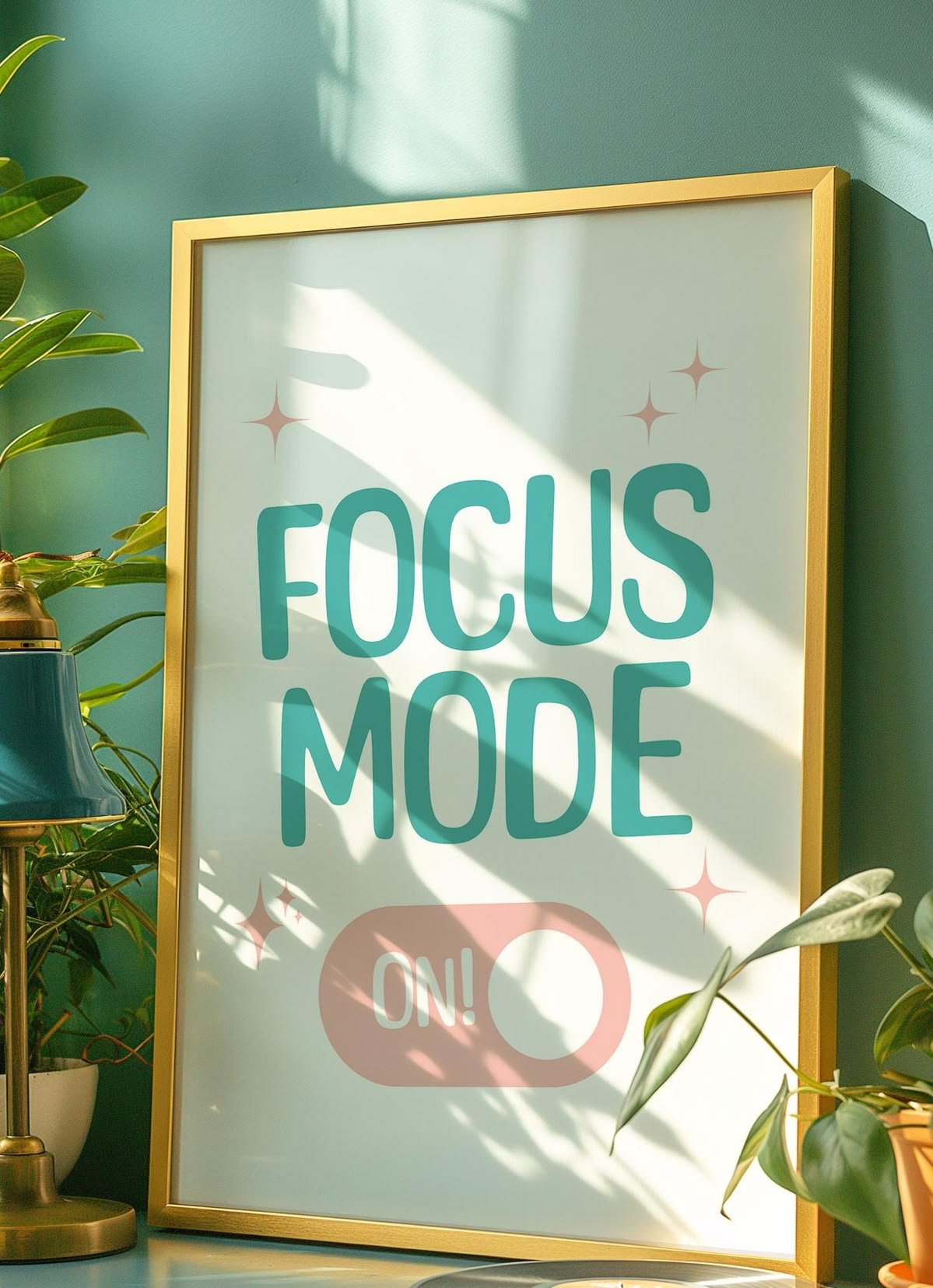
Focus Mode: ON
Mastering the Art of Concentration
Dear Students,
One of the most common things I hear from students today is, “Ma’am, I want to study, but I just can’t concentrate.” You sit down with your books, open the first page, and within minutes you are checking your phone, thinking about something else, chatting with a friend, or suddenly remembering that you absolutely need to rearrange your desk!
If this sounds familiar, don’t worry. You are not alone. Staying focused is not something that comes naturally to everyone. Concentration is a skill, and like any skill, it can be developed with practice.
We live in a world full of distractions. Notifications, social media, games, videos and constant messages are designed to capture our attention. The problem is not that students are incapable of studying; the problem is that our attention is constantly being pulled in different directions.
So, how can we take back control?
Start with One Clear Goal
Before opening your textbook, decide exactly what you want to accomplish. Instead of saying, “I will study Science today,” give yourself a specific target: “I will understand this chapter and solve ten questions.”
A clear goal gives your mind a destination. Once you know what you are trying to achieve, beginning becomes much easier.
Make Your Phone Less Interesting
Let’s be honest—your phone is probably one of your biggest distractions. You may tell yourself, “I’ll just check one notification,” and suddenly twenty minutes have disappeared!
During study time, keep your phone away from your desk. Put it on silent or, if possible, keep it in another room. You don’t have to fight temptation every few minutes if you simply remove the temptation.
Remember: You control your phone; your phone should not control you.
Study in Focused Sessions
Studying continuously for several hours does not necessarily mean studying effectively. Try working in focused sessions with short breaks in between.
For example, study for 30–40 minutes with complete attention, then take a 5–10 minute break. Stretch, drink some water, walk around or simply rest your eyes. Then return to your work.
During those 30–40 minutes, give yourself permission to focus on only one task.
Study Actively, Not Passively
Reading the same page again and again can make you feel like you are studying, but it may not help you remember much.
Instead, close the book and try to explain what you have learned in your own words. Solve problems without looking at the answers. Make short notes. Ask yourself questions. Teach a concept to an imaginary student.
The more actively your brain works, the stronger your learning becomes.
Don’t Wait for Motivation
This is perhaps the most important lesson I want you to remember.
You do not always need to feel like studying before you begin. Sometimes motivation comes after you start, not before.
Tell yourself, “I will study for just ten minutes.” Once you begin, continuing often becomes much easier.
And please remember that taking breaks, sleeping well and spending time with family and friends are not signs of laziness. A tired mind cannot concentrate effectively. Rest is part of productive study, not the opposite of it.
Finally, don’t compare your study habits with everyone around you. Some students can study for two hours at a stretch; others work better in shorter sessions. Find the method that helps you learn effectively.
Your goal is not to study every waking minute. Your goal is to make the minutes you spend studying count.
So, the next time you sit down with your books, put away the distractions, choose one small goal and give it your complete attention.
Less scrolling. More learning. Less distraction. More direction.
And remember:
“You don’t need more hours in the day; you need more attention in the hours you already have.”
Switch on your Focus Mode—and let your goals get the attention they deserve.
— Ankani Kanjilal (Senior School Chemistry Teacher)

