

Floating 250 miles above Earth, you gaze through a window at the swirling blue oceans, thousands of miles from the nearest grocery store. For decades, astronaut meals were limited to silver pouches of dehydrated paste, but a high-tech transformation is taking root on the International Space Station. Beneath a steady, ethereal pink glow, vibrant green leaves stretch toward the stars in the world’s most remote vegetable patch. This is the Space Garden, where science meets soil to bring a taste of home to the final frontier.
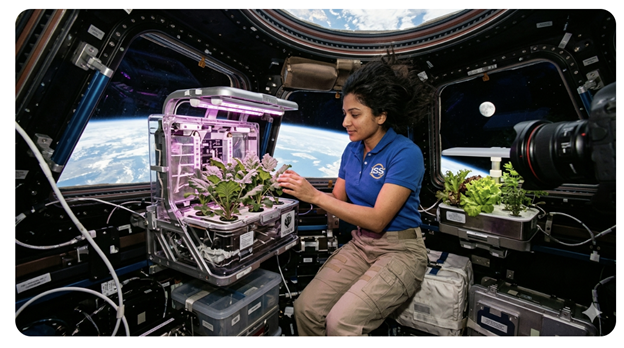 Source: AI generated image
The Science of “Plant Disco” Lights
Ever wondered why a space garden looks like a neon pink party? It’s not for the aesthetic—it’s because plants are incredibly picky “eaters” when it comes to light.
- Custom Color Recipes: Plants don’t need the full rainbow to thrive. They primarily “feed” on red and blue light waves, which provide the most efficient energy for photosynthesis.
- The Pink Glow: When you blend these specific red and blue LEDs, the result is the striking magenta glow you see in the “Veggie” chambers.
- Mission-Critical Efficiency: On the ISS, electricity is a precious resource. By skipping
- green and yellow light—which plants largely ignore—NASA saves massive amounts of energy.
- The Green Secret: Most plants appear green to us because they reflect green light rather than absorbing it. Since the plants don’t “want” that color, scientists simply don’t serve it to them.
- A Touch of Green for Humans: NASA often adds a few white or green LEDs to the mix. This isn’t for the plants; it’s for the astronauts. It makes the vegetables look “normal” and appetizing, and it helps the crew spot any signs of disease or pests that might be hidden under a purple hue.
Challenges of growing space garden
- Water “Hugs” the Roots: In zero gravity, water doesn’t pour; it sticks together in bubbles. It likes to “hug” the roots, which can actually drown the plant if scientists aren’t careful to add air.
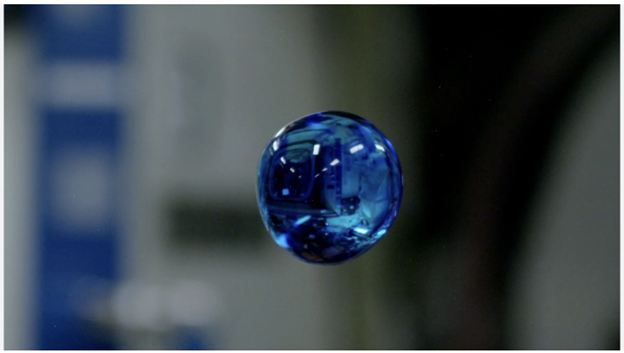
Fig: Water droplet floating in space. [Source CNN]
- No “Down” for Roots: On Earth, roots grow down because of gravity. In space, they are “blind.” Scientists use light to trick them—roots naturally grow away from light, while stems grow toward it.
- The “Pillow” Method: Since there’s no dirt, plants grow in “pillows”—small bags filled with clay and fertilizer that act like a high-tech bed for the seeds.
First space flower
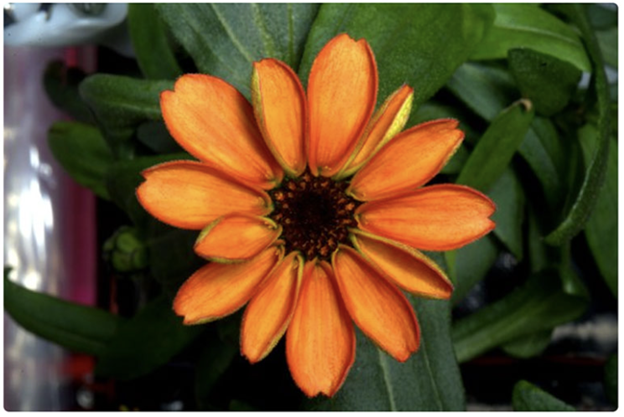
Fig: First space flower, Zinnia
Retrieved from URL: https://www.collectspace.com/news/news-012016a-first-flower-space-station.html
In January 2016, NASA astronaut Scott Kelly showcased the first zinnia flower grown entirely in orbit. These bright orange blooms weren’t just for decoration—they were a major scientific leap forward.
Successfully Grown Space Crops
To date, numerous species have been grown and, in many cases, consumed by crews aboard the International Space Station (ISS) and previous orbital labs:
- Leafy Greens: These are favored for their fast growth and high nutrient density.
- Lettuce: Includes ‘Outredgeous’ Red Romaine, Dragoon, and Waldmann’s Green varieties.
- Kale: Red Russian kale has been successfully harvested.
- Cabbage: Chinese cabbage (Tokyo Bekana) and Mizuna mustard greens.
- Pak Choi: Extra Dwarf Pak Choi and Amara mustard.
- Vegetables & Legumes:
- Chile Peppers: Specifically NuMex ‘Española Improved’ peppers, used by astronauts to make “space tacos”.
- Radishes: Grown in the Advanced Plant Habitat (APH) for their quick 27-day growth cycle.
- Tomatoes: Dwarf tomatoes (Red Robin) have been cultivated to test fruiting in space.
- Cowpea (Lobia): Recently germinated by ISRO’s CROPS mission in 2025.
- Potatoes: White potatoes were first grown in the 1990s as a high-calorie staple candidate.
- Onions & Garlic: Spring onions were notably the first food eaten in space in 1975 on Salyut 4.
- Grains & Others:
- Wheat: Dwarf wheat varieties have been grown for multiple generations to study seed development.
- Rice: Studied for its nutritional potential in future large-scale greenhouses.
- Arabidopsis thaliana: Often called the “white mouse” of the plant world, it is used primarily for genetic research rather than food.
- Flowers: Zinnias and sunflowers have bloomed on the ISS, helping researchers understand the flowering process in microgravity.
Future Space Farmers
Future space farmers will transcend the traditional astronaut role, evolving into specialized biological systems engineers and horticulturalists tasked with managing full scale bioregenerative life support systems.
Beyond their technical utility in recycling air and water, plants serve as a vital psychological anchor. For crews in deep-space isolation, “space gardening” provides a crucial sensory connection to Earth—offering mental stimulation and emotional relief that high-tech hardware cannot replicate.

